
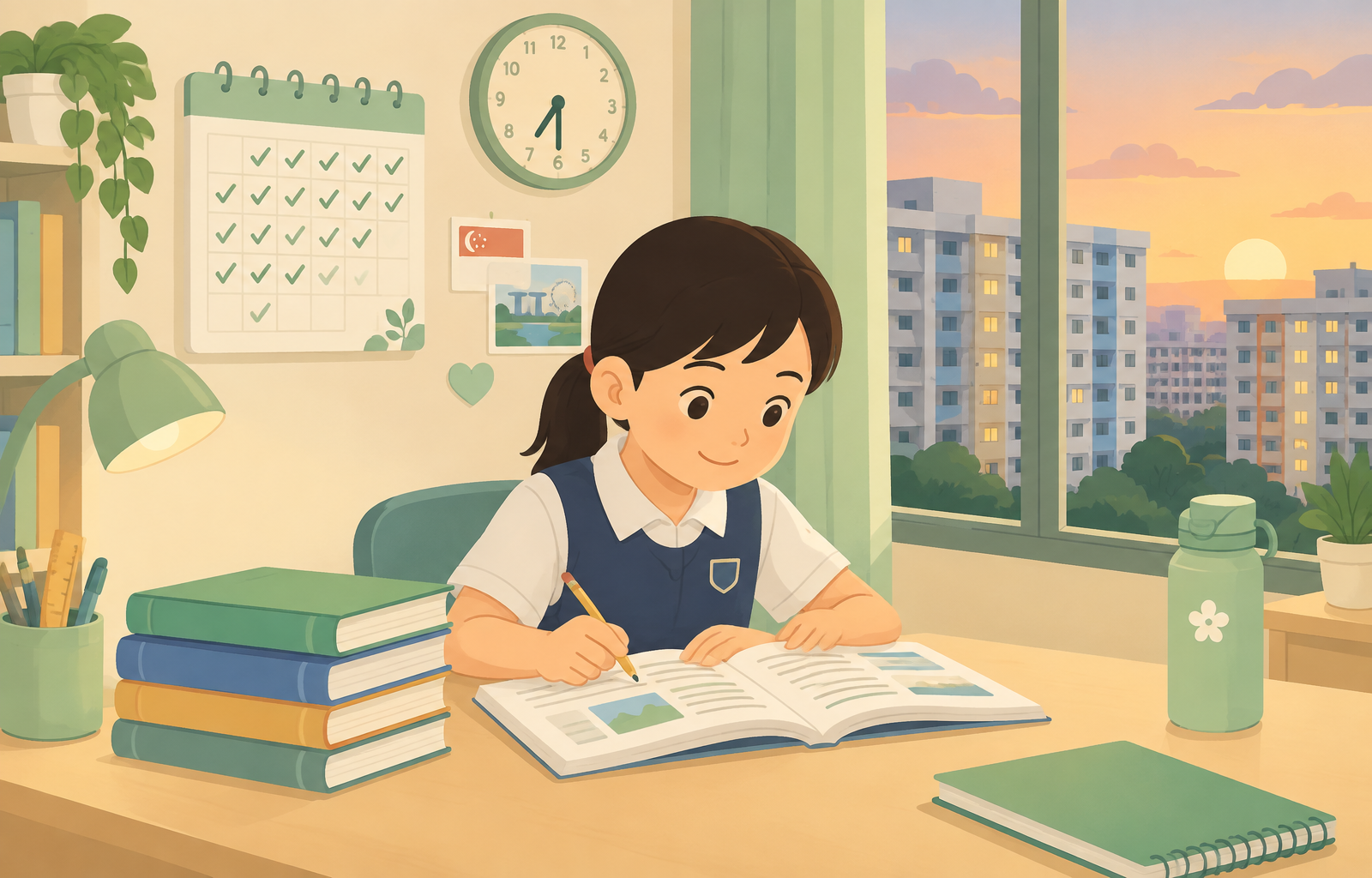
The difference between a child who copes well in Primary 6 and one who struggles is rarely intelligence. It is habits. The routines your child builds in the lower primary years decide how smoothly the PSLE years go. Here is a practical guide for Singapore parents on building study habits that actually stick.
Start with a fixed study time, not a flexible one
'Do your homework whenever you like' sounds kind, but it teaches children that study is optional and negotiable. A fixed daily slot, for example 4pm to 5pm after a snack and a short rest, removes the daily argument. The brain also learns to switch into focus mode at that time automatically, the same way bedtime routines help children fall asleep.
Make the study space boring on purpose
A fixed time only works if the space supports it. A good study desk has the current worksheet, stationery, and nothing else. No phone, no tablet, no toys within reach, and ideally no bed in sight. Children do not need more willpower than adults; they need fewer temptations. If the phone must be nearby for a genuine reason, keep it face down in another room and let your child check it during breaks.
- Same time every day, even on weekends (shorter is fine)
- A clear desk with only what the current task needs
- Phone and tablet in another room, not just silenced
- Short sessions: 25 to 40 minutes, then a real break
- End each session by packing up and noting what is next
Short and daily beats long and occasional
With the time and space settled, the last variable is volume. Thirty minutes of focused work every day does more than a three-hour marathon on Sunday. Spaced practice is one of the most proven findings in learning science: revisiting a topic several times over days builds far stronger memory than one long session. This is especially true for spelling, multiplication tables and Science keywords.
A simple target for most primary school children: two focused sessions of 25 to 40 minutes on school days, with play, dinner and family time protected. Habits that crowd out childhood do not last.
Praise the routine, not the result
Routines need fuel, and the fuel is attention. Children repeat what gets noticed. If praise only comes with full marks, a child learns that effort without a perfect score is worthless, and many stop trying. Instead, notice the habit: 'you sat down at 4pm without being reminded' or 'you checked your working today'. Results follow routines, so reward the routines.
Let your child own the plan
One last ingredient makes the whole system self-sustaining: ownership. Even a Primary 3 child can help decide the order of tasks or choose which subject comes first. Small choices create ownership, and ownership is what turns 'my parents make me study' into 'this is what I do'. By Primary 5 and 6, that shift matters enormously, because no parent can sit beside a child through every exam year.
How we support this at AZKEN
In our small-group classes, students learn the same routines we describe here: fixed practice, checking working, and reviewing mistakes properly. If you would like help building structure around your child's learning, WhatsApp us at 8166 1212 or book a trial class through our Schedule page. If your child is heading into the exam years, our P5 Science exam preparation guide has more practical tips.
Frequently Asked Questions
How long should a primary school child study each day?
Two focused sessions of 25 to 40 minutes on school days is plenty, with play and family time protected. Spaced daily practice builds stronger memory than one long weekend session.
Should my child study on weekends?
A short, light session keeps the routine alive, but weekends should mostly be rest and real breaks. Habits that crowd out childhood do not last.
How do I get my child to study without nagging?
Fix the time and the space, then hand over small choices: which subject comes first, which order of tasks. Ownership turns 'my parents make me study' into 'this is what I do'. Praise the routine, not the result.
What if my child keeps breaking the routine?
Shrink it before abandoning it. Even fifteen focused minutes at the fixed time keeps the habit alive, and a restart after a bad week is normal. Consistency over months matters more than any single day.
Want personalised guidance for your child?
Every student learns differently. At AZKEN, Mr Ken Lim designs personalised learning plans that address your child's specific needs and goals.
Mr Ken Lim
Founder & Lead Educator, AZKEN
- Teaching Mathematics & Science since 2010
- Founder of AZKEN
- Primary Science, Primary Mathematics and Secondary Mathematics educator
With over a decade of experience teaching Science and Mathematics in Singapore, Mr Ken Lim has helped hundreds of students build confidence and achieve their academic goals. He believes every child can excel with the right guidance and encouragement.