
Your child climbs out of the pool on a hot Singapore afternoon and immediately starts shivering. The air is warm, the sun is out, so why do they feel cold? This everyday moment is one of the best ways to understand evaporation and heat transfer, two ideas that appear again and again in Primary Science exams and PSLE Science questions. In this guide, we explain the science in simple words, show you the exact answer structure examiners look for, and share easy home experiments.
Where this fits in the MOE Primary Science syllabus
In the MOE Primary Science syllabus, this topic links two themes. Under Cycles, pupils learn that water exists in three states and changes state through evaporation, boiling, condensation, melting and freezing. Under Energy, pupils learn about heat: heat flows from a hotter place to a colder place, and objects gain or lose heat. Exam questions on 'feeling cold after swimming' test whether your child can connect these two ideas in one clear explanation.
Key terms your child should use: evaporation, gain heat, lose heat, water vapour, temperature, change of state, and factors affecting the rate of evaporation.
The simple explanation: water droplets take heat from the skin
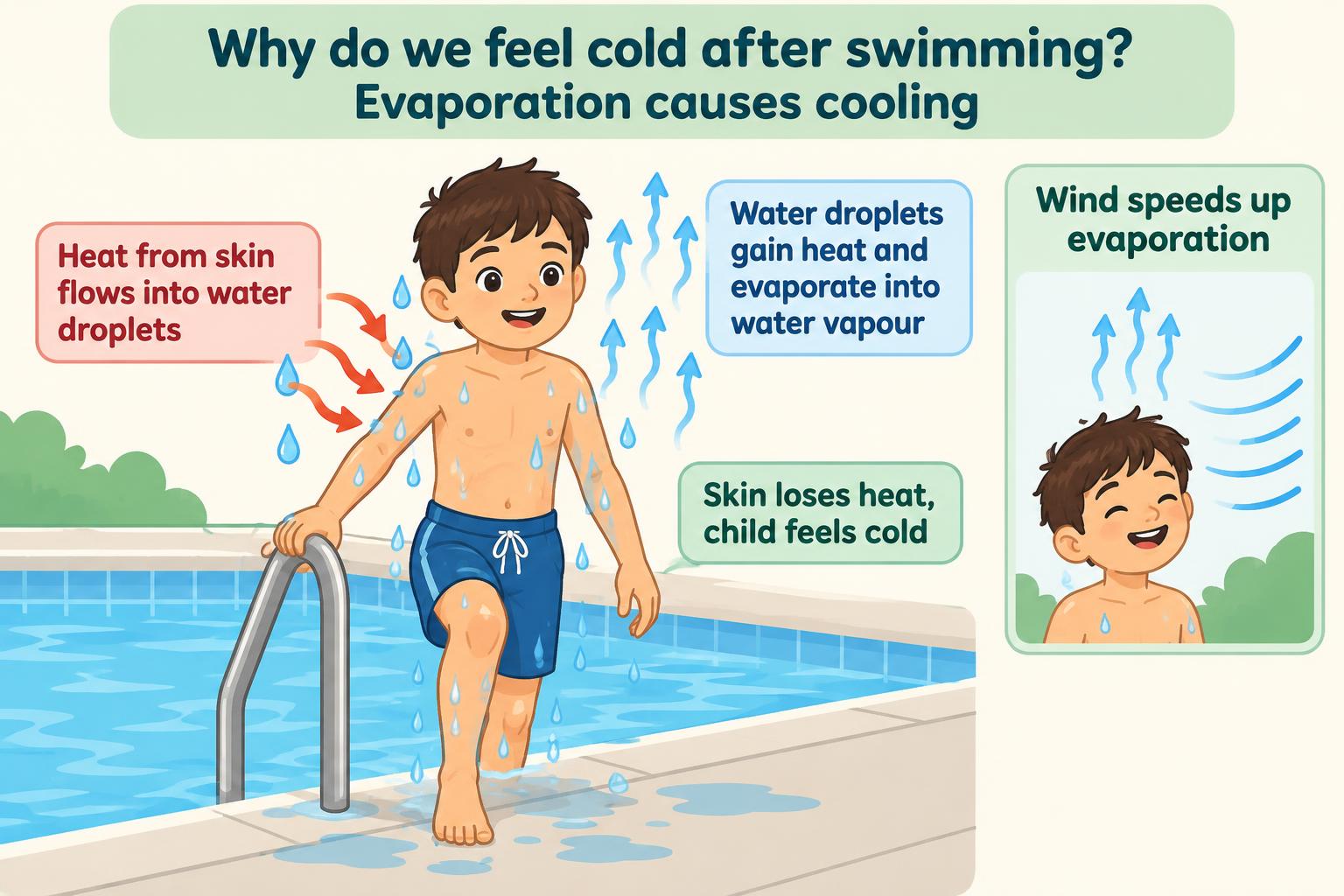
With the syllabus picture in place, the explanation itself is simpler than most parents fear. When your child leaves the pool, their skin is covered with tiny water droplets. For water to evaporate (change from liquid water into water vapour), it needs to gain heat. The nearest source of heat is your child's warm skin.
- Step 1: Water droplets on the skin are cooler than the skin, so heat flows from the warmer skin to the water droplets.
- Step 2: The water droplets gain heat and evaporate into water vapour, which escapes into the surrounding air.
- Step 3: As the skin loses heat to the evaporating water, the temperature of the skin drops.
- Step 4: The child feels cold.
One line to remember: evaporation causes cooling, because the water gains heat from the skin, so the skin loses heat.
In my Science classes, this is one of the first questions I use to test whether a student truly understands heat or has only memorised phrases. Many children can recite 'evaporation causes cooling' perfectly, yet still write 'the cold wind made me cold' in the exam. The ones who score well are those who can trace the heat step by step: from skin, to water droplet, to water vapour. That tracing habit is what we drill, because it transfers to every other heat question in the paper.
Why it feels even colder when it is windy
Once children can explain the basic version, exam questions push one step further. Standing under a fan or in a breeze by the pool makes children feel colder still. Wind blows away the water vapour near the skin, so more water can evaporate faster. A faster rate of evaporation means the skin loses heat faster. The same idea explains why wet clothes on an HDB bamboo pole dry faster on a windy day.
Other factors that affect the rate of evaporation, and which MOE questions often test, include temperature of the surroundings, humidity of the air, and exposed surface area. On a humid Singapore day, evaporation is slower because the air already holds a lot of water vapour.
Common mistakes children make in exam answers
Knowing the right explanation is half the battle. These are the wrong turns we mark most often:
Saying 'the cold water makes me cold'
Pool water may not be cold at all. The key reason is evaporation of the water on the skin, not the temperature of the pool. Children lose marks for missing the word evaporation.
Saying 'the coldness enters the body'
There is no such thing as 'cold' flowing. Only heat flows. The correct idea is that the skin loses heat to the water droplets.
Saying 'the water loses heat when it evaporates'
This is backwards. Water must gain heat to evaporate. Many students mix up gain and lose, so practise writing 'the water gains heat from the skin and evaporates'.
Mixing up evaporation and boiling
Evaporation happens at any temperature, only at the surface of the water, and slowly. Boiling happens at 100°C throughout the water. Water on skin evaporates; it does not boil.
A model PSLE Science answer
Put the right science and the right wording together, and this is what a full-mark answer looks like:
Question: Ali came out of the swimming pool and felt cold even though the day was hot. Explain why.
Model answer: The water on Ali's skin gained heat from his skin and evaporated. His skin lost heat, so he felt cold.
Notice the three marking points: who gains heat (the water), the process (evaporation), and the effect (skin loses heat, feels cold). Teach your child to check each answer for all three.
Easy home experiments to make it click
Reading about evaporation is one thing. Feeling it happen is another. These four experiments make the idea click at home:
- Wet hand test: wet one hand and keep the other dry. Blow on both. The wet hand feels much colder because evaporation takes heat from the skin.
- Fan test: wet two handkerchiefs and hang one under a fan, one away from it. Check which dries first, and talk about why wind increases the rate of evaporation.
- Thermometer test: wrap wet tissue around one thermometer bulb and leave another dry. After a few minutes, the wet one shows a lower temperature.
- Everyday spotting: sweating after PE, a cooling towel at a hawker centre, or alcohol wipes feeling cold all show the same idea.
How AZKEN helps with Primary Science
These experiments work because they make the concept personal, which is the same principle our lessons are built around. At AZKEN in Ang Mo Kio, our small-group Primary Science tuition teaches concepts like evaporation and heat through hands-on examples, then trains children to write precise answers using MOE keywords. If your child understands the topic in class but still loses marks in exams, a structured answering method often makes the biggest difference. For the wider topic this question sits in, read our parent's guide to heat transfer for primary school students.
Have a question about your child's Science? WhatsApp us at 8166 1212 or book a trial class through our Schedule page.
Frequently Asked Questions
Why does my child feel cold after leaving a swimming pool?
Water droplets left on the skin gain heat from the body and evaporate. As the skin loses heat to the evaporating water, its temperature drops, so the child feels cold. This is why it happens even on a hot day.
Is evaporation in the MOE Primary Science syllabus?
Yes. In the official MOE Primary Science syllabus, it sits under the Cycles theme (changes of state of water) and connects to the Energy theme (heat). Questions about feeling cold after swimming test whether your child can connect both ideas in one explanation.
What keywords earn marks in evaporation questions?
Examiners look for precise phrases such as 'gains heat', 'evaporates', 'water vapour' and 'rate of evaporation'. Everyday wording like 'the cold wind made me cold' does not score the marking point.
Why does wind make the pool feel even colder?
Wind blows away the water vapour near the skin, so water evaporates faster. A faster rate of evaporation means the skin loses heat faster, which is why a breeze makes a wet child shiver more.
Want personalised guidance for your child?
Every student learns differently. At AZKEN, Mr Ken Lim designs personalised learning plans that address your child's specific needs and goals.
Mr Ken Lim
Founder & Lead Educator, AZKEN
- Teaching Mathematics & Science since 2010
- Founder of AZKEN
- Primary Science, Primary Mathematics and Secondary Mathematics educator
With over a decade of experience teaching Science and Mathematics in Singapore, Mr Ken Lim has helped hundreds of students build confidence and achieve their academic goals. He believes every child can excel with the right guidance and encouragement.